Paper Napkin Specification Guide
Folded vs Unfolded Paper Napkin Size
Direct answer
Unfolded size is the full sheet when the napkin is opened. Folded size is the outside size after folding. Record both dimensions and the fold type; writing only ‘napkin size’ leaves the specification unclear.
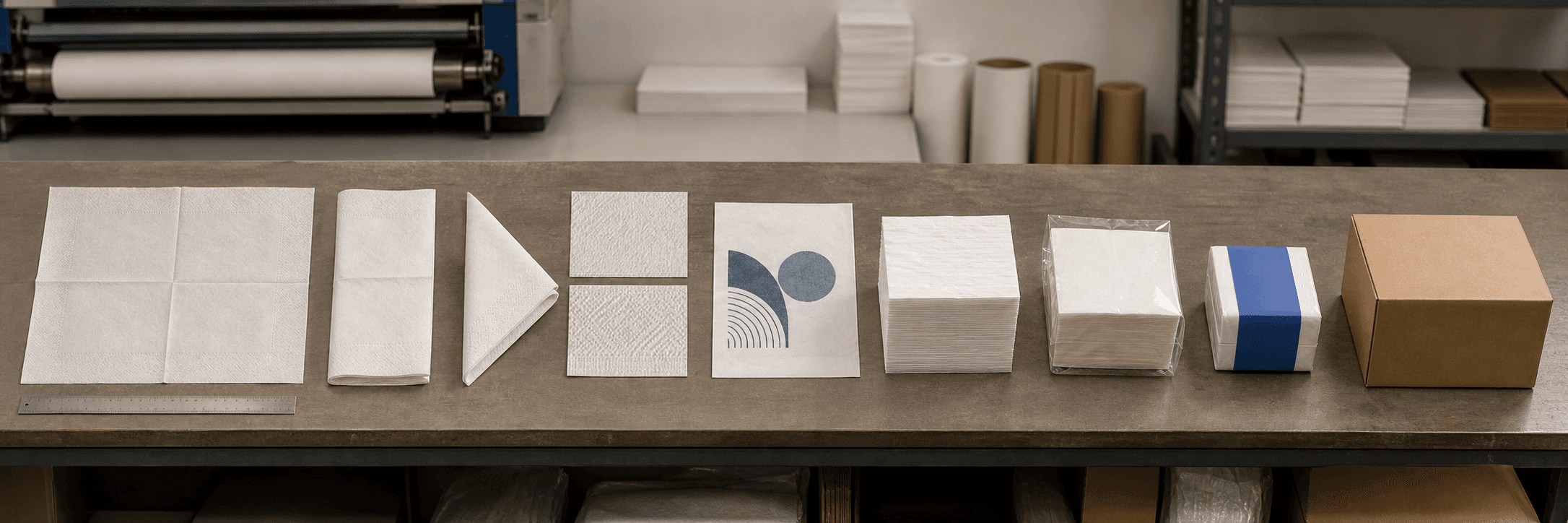
Three separate fields
Start with the open sheet, the folded footprint and the fold type.
- Unfolded size
The width and length of the sheet when the napkin is fully opened.
Record the full sheet as width × length and include the unit.
- Folded size
The width and length of the napkin in its finished folded form.
Record the outside folded footprint as width × length and include the unit.
- Fold type
The folding pattern used to turn the open sheet into the finished format.
Keep it as a separate field because dimensions alone do not show the fold sequence.
Illustrative specification only
Write three separate fields.
This example shows the notation only. It is not a fixed TISVEN size or a universal paper napkin standard.
- Unfolded size
- 300 × 300 mm
- Folded size
- 150 × 150 mm
- Fold type
- 1/4 fold
Why the label is ambiguous
One “napkin size” does not identify the finished format.
A supplier still needs to know whether the number describes the fully opened sheet or the napkin after folding.
- 01
The same open sheet can finish differently.
A different folding pattern can change the finished footprint and presentation even when the unfolded sheet is unchanged.
- 02
A folded footprint does not describe the full sheet.
Knowing only the folded width and length does not confirm the unfolded dimensions or the folding pattern.
- 03
Orientation and units still need labels.
State width, length and unit clearly. Add a reference image or sample when the orientation could be read in more than one way.
What buyers should record
Keep each dimension and product field visible.
Use the fields you already know. Mark the rest for review instead of combining them into one unclear size.
- Unfolded width
- One side of the fully opened sheet.
- Unfolded length
- The other side of the fully opened sheet.
- Folded width
- One side of the finished folded footprint.
- Folded length
- The other side of the finished folded footprint.
- Fold type
- The named or illustrated folding pattern.
- Ply
- The number of tissue layers in the napkin.
- GSM, if relevant
- Include the target basis weight when it is part of the project specification.
- Pack count
- The number of finished napkins required in each pack.
- Print or artwork requirement
- Note whether the napkin needs printing and provide the available artwork reference.
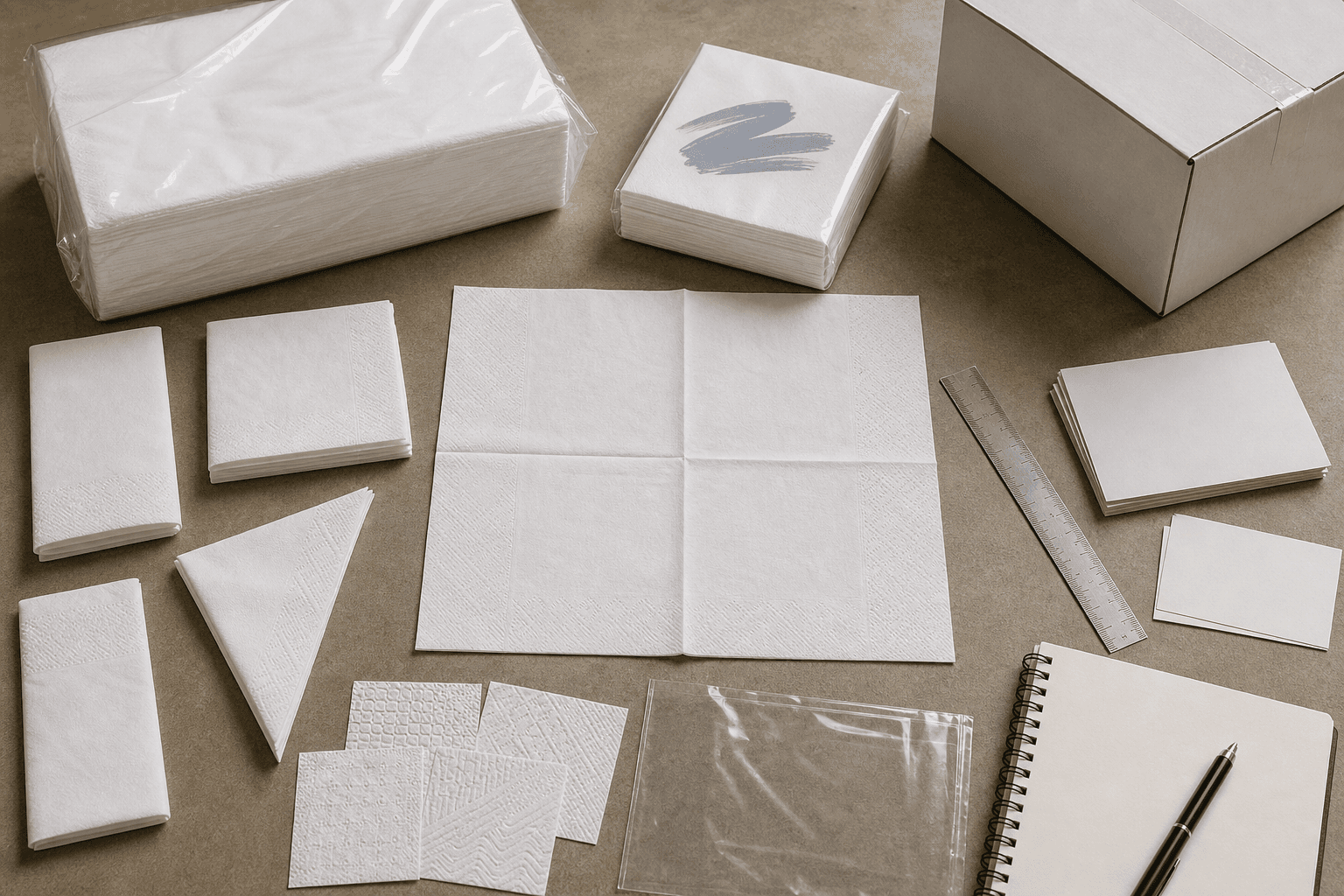
Illustrative review layout
A visual reference does not replace the written fields.
The illustration groups open and folded napkin shapes, packaging, a ruler and note space. Use it to explain what should be recorded, not as proof of a factory test, customer order or fixed production specification.
Before sending the RFQ
Use one short specification block.
Fill the fields you know. If one is open, label it for review instead of hiding it inside a single size.
Paper napkin RFQ template
- Product: Paper napkin
- Unfolded size:
- Folded size:
- Fold type:
- Ply:
- Pack count:
- Reference image/sample:
Ready for a clearer specification
Send the open size, folded size and fold type you know.
TISVEN can review the dimensions, tissue construction, pack count and artwork direction you provide before quotation.