Pocket Tissue & Toilet Roll / Shipping Volume
Tissue Shipping Volume: Compare CBM per Pack and per Roll
Quick answer
Keep the product specification and order quantity the same. Compare the external volume of each filled, closed shipping package, then calculate the volume for the whole order—not just one carton or bag.
Use m³ per 1,000 individual pocket packs or m³ per 1,000 toilet rolls to compare like with like. A smaller carton can require more cartons, so it may produce a larger shipment.
Lower calculated CBM does not prove adequate protection, actual container loading or a lower freight bill.
01 / Start with the same comparison
What does this CBM describe?
One shipping package
m³ / carton or filled bagThe space occupied by a complete, closed package—including its contents and outer packaging.
The same product quantity
m³ / 1,000 packs or rollsShipping-package volume allocated to a fixed quantity. It is not the physical volume of the tissue alone.
The whole order
m³ / orderThe total for the agreed quantity and final shipping arrangement. Include partial packages separately.
02 / Put the figures on one basis
Measure outside. Compare equal quantities.
Keep pocket packs and toilet rolls on separate lines. For a mixed order, add their shipping volumes—not unlike product counts.
Rectangular shipping package
CBM = L × W × H ÷ 1,000,000
Use filled, closed external dimensions in centimetres. The result is cubic metres (m³).
Volume per 1,000 of the same product
Package CBM ÷ count inside × 1,000
Use individual pocket packs for one comparison, or toilet rolls for another. For packages with different counts or sizes, calculate each group separately.
03 / Same 6,000 packs. A different shipment.
The smaller carton can make the larger shipment
Hypothetical example: identical individual pocket packs, 6,000 packs in each order, no pallets. These are not TISVEN carton specifications or a tested packing arrangement.
Option A
- Outside dimensions
- 50 × 40 × 30 cm
- One carton
- 0.060 m³
- Individual packs / carton
- 300
6,000 ÷ 300 = 20 cartons
20 × 0.060 = 1.20 m³
0.200 m³ per 1,000 individual packs
Option B
- Outside dimensions
- 40 × 40 × 30 cm
- One carton
- 0.048 m³
- Individual packs / carton
- 200
6,000 ÷ 200 = 30 cartons
30 × 0.048 = 1.44 m³
0.240 m³ per 1,000 individual packs
A has the lower calculated volume here. That does not establish whether either arrangement fits, protects the product or loads successfully. For partial cartons or mixed sizes, use each package’s actual count and dimensions rather than rounding the order into full cartons.
For the difference between individual packs, multipacks and order units, see Pocket Tissue Carton Packing.
04 / Same calculation, different checks
Pocket packs and toilet rolls need separate comparisons
Pocket tissue: check the filled carton
Keep the individual pack specification and selling configuration unchanged. If carton construction or the bundle arrangement changes, ask for the revised filled outer dimensions and confirmed pack count.
“Thinner board” does not by itself prove a smaller outside volume. Measure the closed package without squeezing it, including any bulging sides.
Review closure, handling and stacking protection as well as volume. A material change is a proposal to check—not an automatic improvement.
DHL’s packaging guidance treats fit, protection and measurement together; it does not validate a particular tissue packing change.
Toilet rolls: check the filled bag
Keep the roll specification and roll count unchanged. A smaller roll containing less tissue is a product change, not evidence of better packaging.
Confirm roll arrangement, rolls per bag and any individual wrapping. A flat empty bag’s width and length cannot replace the dimensions of the filled, sealed pack.
Measure the filled package at its outermost points without compressing the rolls. For an irregular bag, a rectangular bounding-box volume is an estimate; confirm the carrier’s measurement method.
Is the bag the final shipping package, or will it travel inside a carton or on a pallet? Compare the complete arrangement and review protection before choosing a carton-free option.
05 / Measure the shipping state
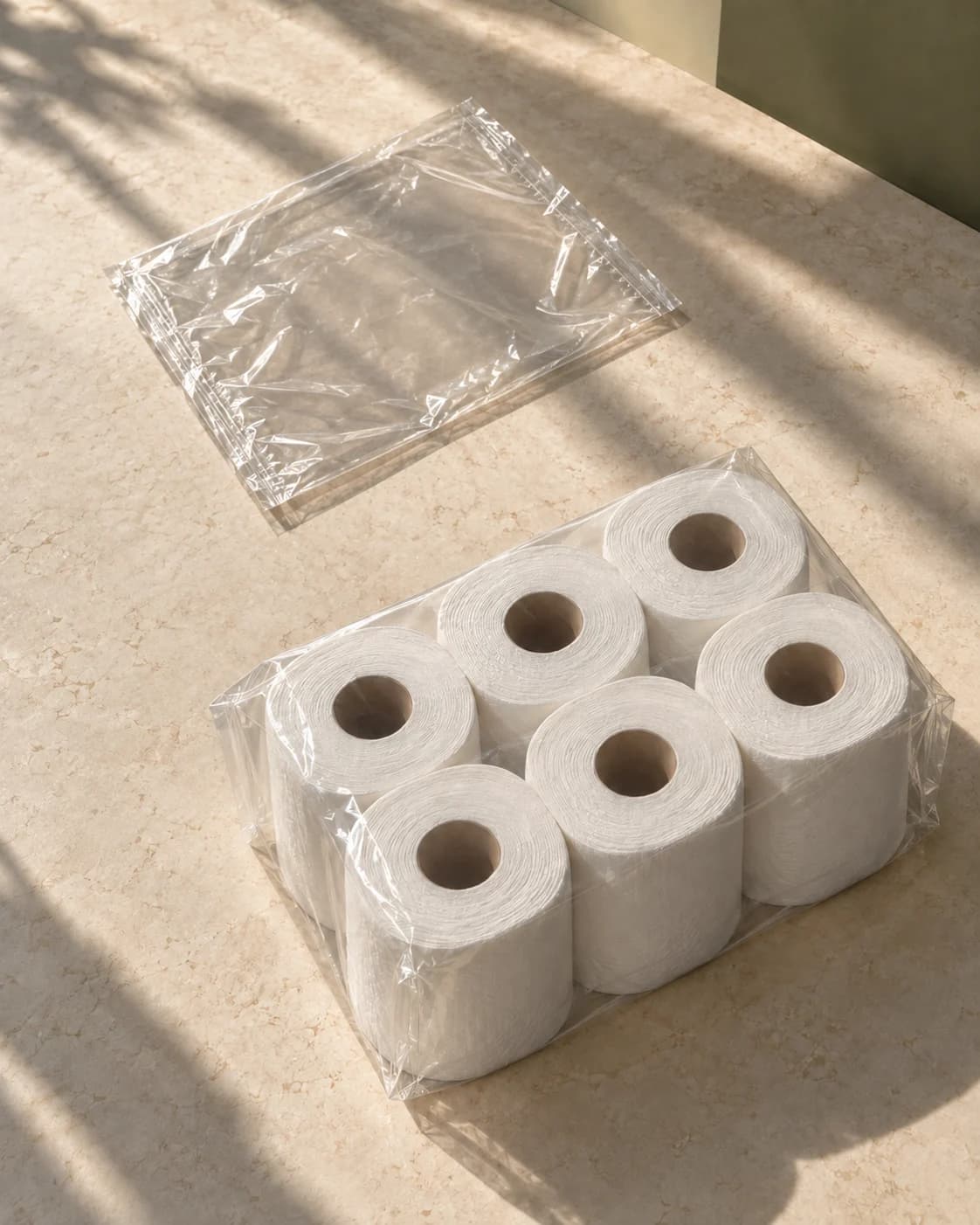
A flat bag is not a filled package
Empty bag
Use flat dimensions to specify the bag—not to calculate the filled shipment.
Filled package
Use the outermost points, including bulges and closure. Do not squeeze the rolls.
Dimension diagrams only. The box outline represents the filled package’s outer envelope—not rigid packaging or a measured volume.
06 / Volume is not the loading plan
Lower CBM still needs a loading and freight check
Container volume ÷ package volume does not prove how many packages will fit. Package dimensions, door clearance, orientation, stacking limits, weight distribution and securing all affect the loading plan.
Hapag-Lloyd notes that container specifications can vary with the manufacturer. Check the equipment intended for the shipment. The CTU Code provides guidance on packing and securing cargo; it is not a fixed tissue loading allowance.
Ask the forwarder to price both options on the same route and service basis. CBM is volume, not automatically chargeable weight. DHL’s chargeable-weight guidance distinguishes actual and dimensional weight for its services; do not apply a parcel formula to an ocean-freight quotation.
07 / Ask for a comparison you can verify
Send one clear comparison request
Please compare the two packaging options for the same tissue specification and order quantity. For each option, provide the filled outer dimensions, packs or rolls per shipping package, package count and gross weight. State whether pallets or other outer packaging are included. Please distinguish proposed dimensions from measured sample dimensions, and a calculated loading plan from an actual loading trial. Identify any protection or handling points still to be confirmed.
Measured sample dimensions describe that sample. They do not by themselves prove production consistency or a successful container load. Keep unmeasured proposals labelled as estimates.
Compare your tissue packaging options
Start with the product specification and quantity you want to keep unchanged, then share the packaging alternatives for review.