Pocket Tissue / Packing & Order Units
Pocket Tissue Carton Packing: Packs, Multipacks and Order Units
Quick answer
Count the packs. Name the unit.
Use this formula for identical multipacks. For an order total, cartons must also share the same packing configuration.
Mixed configurations? Calculate each separately. No multipack? Record individual packs per carton directly.
Full calculation conditions
For a uniform packing configuration, individual packs per carton = individual packs per multipack × multipacks per carton. This assumes every multipack contains the same number of individual packs. To calculate an order from its carton count, each carton must also contain the same number of multipacks.
Calculate different configurations separately, then add their individual-pack totals. Keep tissues per individual pack separate. Before accepting a quote, confirm whether its quantity and price refer to an individual pack, a multipack or a shipping carton.
If there is no multipack, record individual packs per carton directly.
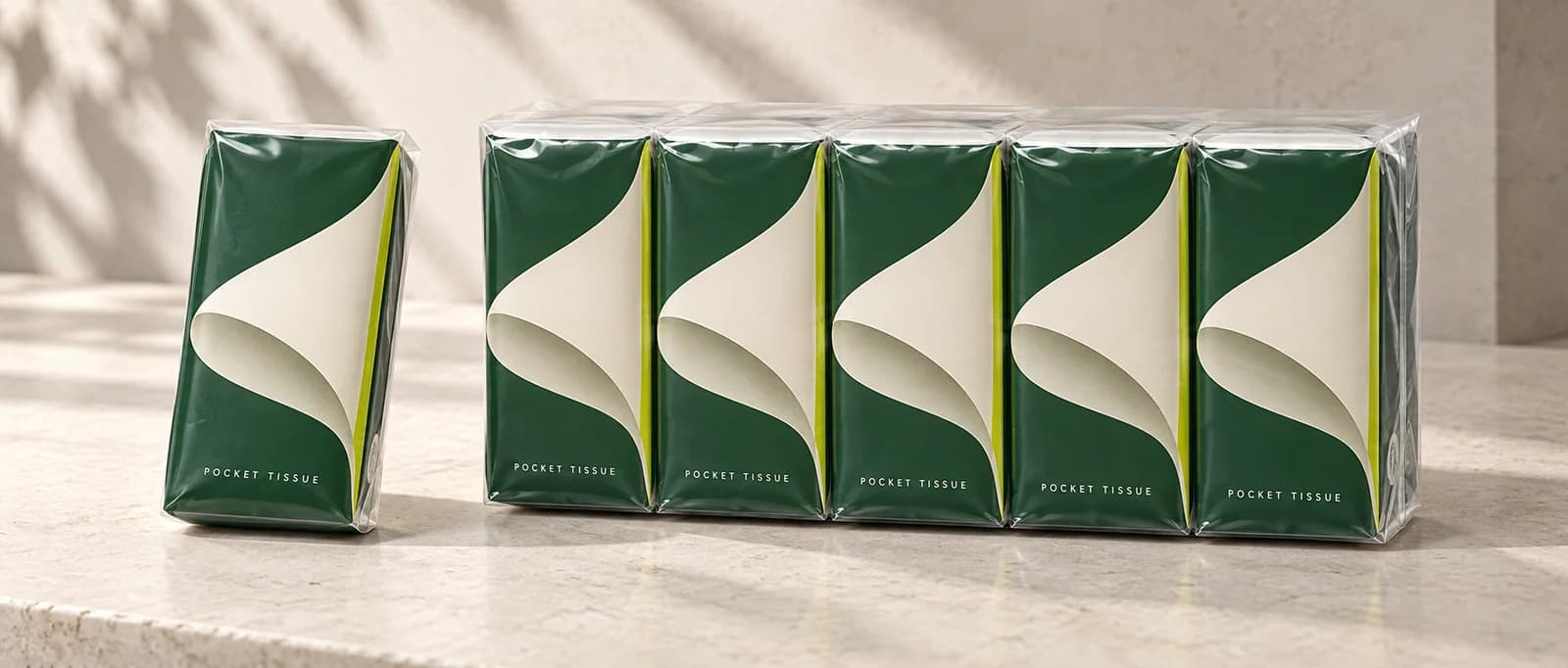
What does “pack” mean on this quote?
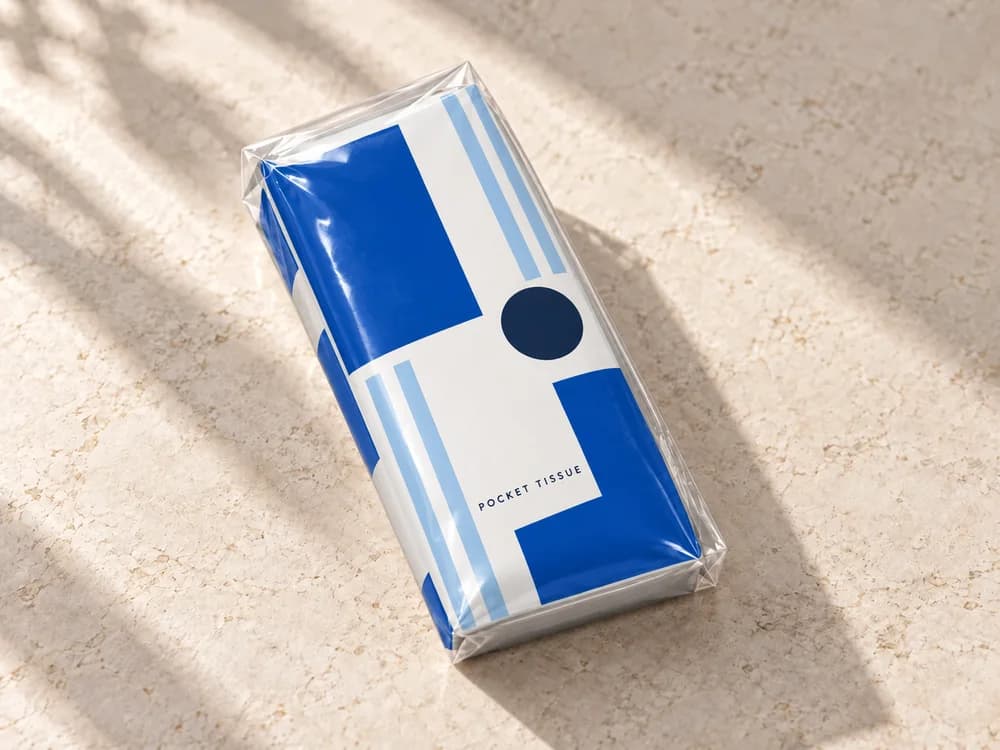
Write out the packaging levels instead of relying on “pack,” “bag” or an unlabeled number string.
- 01Individual pack
- One small wrapper containing pocket tissues
- 02Multipack or bundle
- Several individual packs grouped in an outer wrap or bag
- 03Shipping carton
- The outer shipping box containing individual packs or multipacks
A multipack is not automatically a retail selling unit. Confirm which unit the buyer intends to sell.
Hypothetical quantity diagram — Example A
Individual pack → multipack → carton
- 1
Individual pack
small wrapper
- 5
Multipack
individual packs
- 48
Carton
multipacks = 240 individual packs
Definitions, what to record & public sources
| Term used in this guide | Meaning | What to record |
|---|---|---|
| Individual pack | One small wrapper containing pocket tissues | Physical tissues inside each individual pack |
| Multipack or bundle | Several individual packs grouped in an outer wrap or bag | Individual packs per multipack |
| Shipping carton | The outer shipping box containing individual packs or multipacks | Multipacks per carton, if used, and total individual packs per carton |
| Order unit | The unit used to state the purchase quantity | Individual packs, multipacks or cartons |
A multipack is not automatically a retail selling unit. It may be intended for retail sale, distribution or handling. Confirm which unit the buyer intends to sell rather than assuming that either the smallest wrapper or the bundle is the retail unit. GS1’s packaging-level guidance distinguishes consumer units, intermediate packs and shipping cases.
For example, National Hospitality Supply’s published pocket tissue configuration lists 36 bags × 10 individual packs, with 15 tissues per individual pack. That gives 360 individual packs or 5,400 tissues—not 360 outer bags. This is that supplier’s listed configuration, not a TISVEN specification or an industry standard. Product reference
The same carton count can hide a different bundle count
Hypothetical packaging-count examples only—not available packing specifications.
Example A
240 individual packs / carton
48 selling units only if each multipack is sold as one unit.
Example B
240 individual packs / carton
24 selling units only if each multipack is sold as one unit.
Same individual-pack count. Different multipack count. This does not prove equal size, cost, quality or packing feasibility.
Comparison table & what the calculation does not prove
The following numbers are hypothetical packaging-count examples only. They do not describe measured cartons or available TISVEN packing specifications.
| Packing field | Example A | Example B |
|---|---|---|
| Individual packs per multipack | 5 | 10 |
| Multipacks per carton | 48 | 24 |
| Individual packs per carton | 5 × 48 = 240 | 10 × 24 = 240 |
| Bundle count, if each multipack is sold as one unit | 48 | 24 |
Both examples contain 240 individual packs per carton, but different numbers of multipacks. If your purchase order is for multipacks, substituting one configuration for the other changes the number of ordered units.
The arithmetic does not establish equal carton dimensions, shipping volume, packing feasibility, cost or product quality. Those require separate confirmation for the selected configuration.
Check the price unit before comparing totals
From a carton quote
Price per individual pack = quoted price per carton ÷ individual packs per carton.
From a multipack quote
Price per individual pack = quoted price per multipack ÷ individual packs per multipack.
If the quotation is in USD, the converted result is USD per individual pack. Conversion does not change the currency or what the quoted price includes.
Use these calculations when the quoted unit and its contents are confirmed and the individual packs have the same specification. For a carton containing differently priced products, dividing the carton total by all packs gives only a blended average—not the price of each product.
Confirm the quoted contents and specification first. Matching units alone does not make two quotes comparable.
Quote conditions, mixed products & comparison checklist
Ask the supplier to state one of these explicitly:
- Price per individual pocket pack.
- Price per multipack containing a stated number of individual packs.
- Price per carton containing a stated number of individual packs.
Putting prices on the same quantity basis does not make the offers equivalent. Compare tissue specifications, packaging, order quantities, currencies, delivery terms and separately charged printing costs before judging the difference.
What happens if the order does not fill whole cartons?
Hypothetical 240-pack carton
The remainder is a calculation, not an approved packing arrangement. Buyer and supplier must agree whether to use a partial carton, revise the packing or change the order quantity. Do not assume partial cartons or mixed products are accepted, and do not round the order up without agreement.
Full-carton calculation
Using the hypothetical 240-pack carton, an order for 1,000 individual packs equals four full cartons plus 40 packs. Five full cartons would contain 1,200 packs.
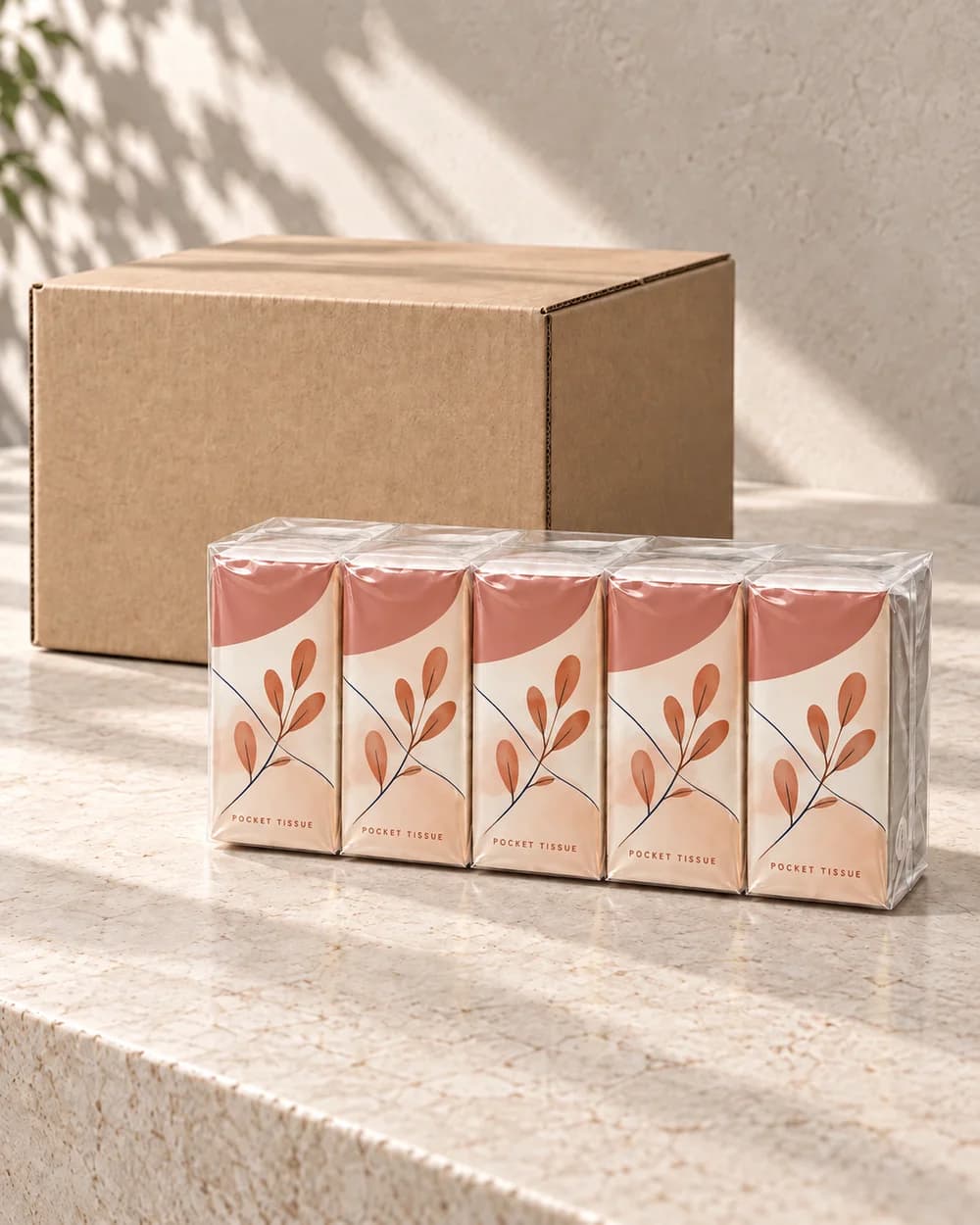
Put the agreed counts in one packing record
Fully hypothetical example—not a specification, MOQ or packing commitment.
- Product / artwork reference:
- Example A, one design and one tissue specification.
- Contents:
- 10 physical tissues per individual pack.
- Multipack:
- 5 individual packs per multipack.
- Carton:
- 48 multipacks per carton = 240 individual packs per carton.
- Order:
- 10 identical full cartons = 480 multipacks = 2,400 individual packs.
- Price unit:
- USD per carton containing 240 individual packs; no price amount is assumed.
- Remainder / mixing:
- No partial carton and no mixed designs or specifications in this example.
Blank template — record your agreed values
Use this short template for the actual agreement:
| Field | Agreed value |
|---|---|
| Product / artwork reference | ___ |
| Physical tissues per individual pack | ___ |
| Individual packs per multipack, or no multipack | ___ |
| Multipacks per carton, if applicable | ___ |
| Total individual packs per carton | ___ |
| Order quantity and ordering unit | ___ |
| Quoted currency and price unit | ___ |
| Full cartons and any agreed partial or mixed packing | ___ |
How to document a sample or mixed configuration
For a sample check, photograph the unopened carton and its label, then record the groups and individual packs found inside. Treat that as evidence for the sample checked—not proof that every production carton has been inspected.
If designs, specifications or packing configurations differ, keep separate quantity lines. For an agreed mixed carton, calculate each line from its own pack counts before adding the total.
Need to confirm the tissue or wrapper first? Use the pocket tissue size guide for measurements and the pocket tissue packaging guide for opening, seals and artwork.
Discuss your pocket tissue packing plan
Review TISVEN’s OEM pocket tissue options, then send your intended selling unit, order quantity with units, and any existing packing reference through the inquiry page. Mark unconfirmed counts as open for review rather than filling them with assumptions.